
Directly supports cellular energy production and mental focus.
Explore NAD+You train consistently, you eat reasonably well, you get to bed on time, and you still run out of energy by the middle of the afternoon. Fatigue like that is common, and it usually has a cause that can be found. Rx2BFIT starts with a medical evaluation, then uses physician-guided therapies that may support cellular energy, recovery, and the way your body restores itself overnight.

Energy is made in two places: inside your cells and during your nights. In the cell, mitochondria turn nutrients into usable energy, and a coenzyme called NAD+ takes part in hundreds of those reactions. At night, the body does its repair work. Growth hormone is released in bursts rather than a steady stream, and the largest bursts come during deep sleep. When either side falls short, training feels harder and recovery takes longer than it should.
Both shift with age. Human studies suggest NAD+ falls modestly in some tissues as we get older, although those studies are small and the size of the decline is often overstated. Deep sleep shrinks too. In one study of 149 healthy men, the deepest stage of sleep fell from about 19 percent of the night in early adulthood to about 3 percent by midlife, and growth hormone release fell in parallel. Activity matters as much as age: exercise-trained older adults had muscle NAD+ levels close to those of young adults.
Most persistent fatigue, though, has an ordinary explanation. Anemia, thyroid disease, sleep apnea, depression, medication effects, and low iron or B12 are all common, and all of them can be tested for. Our article on whether NAD+ declines with age walks through what the research does and does not show about restoring it. Ruling out the ordinary causes comes before any wellness therapy.
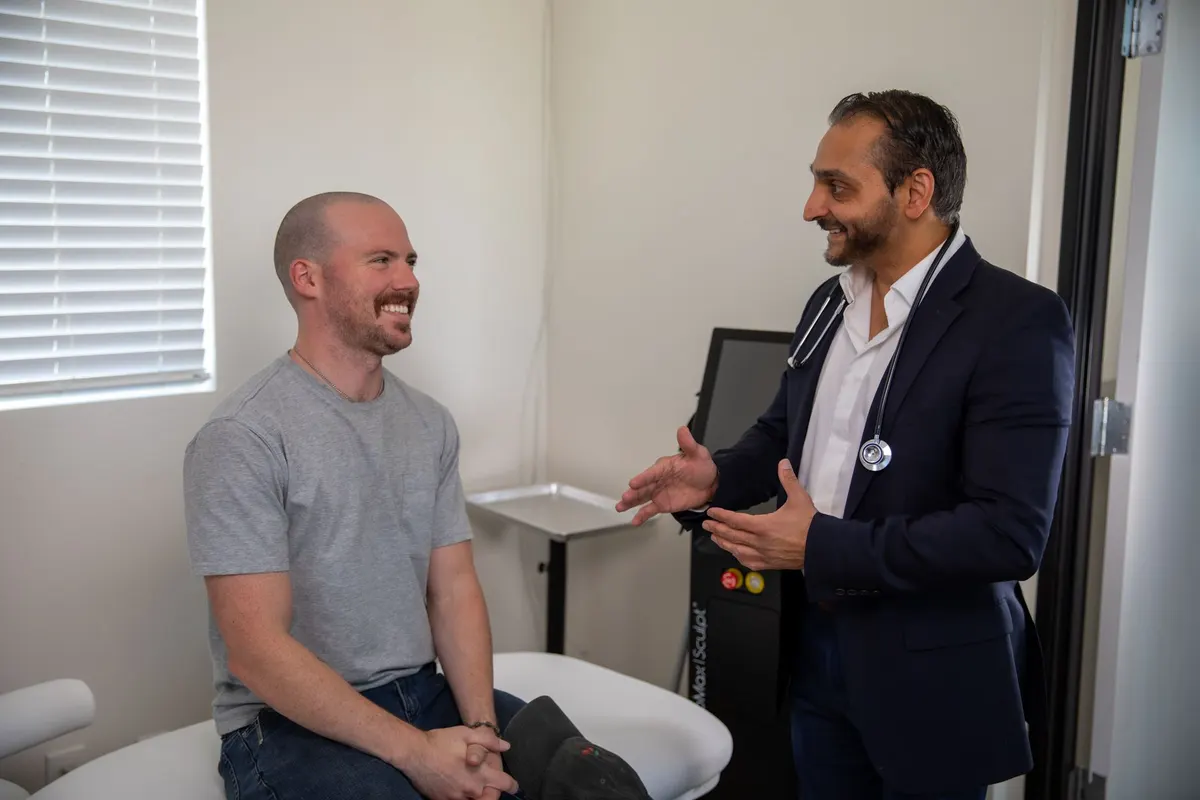
That is why the first step here is an evaluation with Dr. Patel, not a prescription. What you are treated with depends on what is actually behind your fatigue.
The three therapies we use for this concern come at energy from two directions. One supplies a molecule your cells already use to produce energy. The other two prompt your pituitary gland to release more of your own growth hormone, the signal tied to overnight repair and recovery.
NAD+ is a coenzyme found in every cell, central to energy production, cellular repair, and metabolism. Therapy aims to support that supply, and it may help with energy and mental focus. The evidence deserves a plain description: in controlled trials, oral NAD+ precursors reliably raised blood NAD+ levels but did not improve fatigue scores compared with placebo, and injectable NAD+ has very little published human research. NAD+ therapy is not FDA approved for any indication.
Sermorelin is a copy of the first 29 amino acids of growth hormone releasing hormone, the brain's own signal to the pituitary. It prompts a short burst of your own growth hormone that stays under the body's normal feedback control, rather than supplying the hormone directly. It is used to support energy, recovery, and body composition over the long term. It is not FDA approved, and the sermorelin Rx2BFIT uses comes from a U.S.-based supplier whose batches are independently tested for identity and purity, with a certificate of analysis on file, not from a compounding pharmacy.
Tesamorelin / Ipamorelin pairs two peptides that reach the same growth hormone pulse by different receptors. Tesamorelin is another analog of growth hormone releasing hormone, and Ipamorelin acts on the ghrelin receptor. The pairing is used in recovery programs with sleep quality and recovery in mind. Tesamorelin is FDA approved only for excess abdominal fat in adults with HIV-associated lipodystrophy, so this use is off-label, and Ipamorelin is not FDA approved for any use.

The choice follows the pattern of your fatigue. When the complaint is flat daytime energy and foggy focus, NAD+ is usually the first conversation. When it is slow recovery, training that leaves you drained, or changes in body composition, a growth hormone releasing peptide may fit better. Some patients are better served by treating a thyroid, iron, or sleep problem and nothing else.
Expect a slow timeline. A growth hormone pulse produces no sensation, and in the small studies of sermorelin, a blood marker called IGF-1 rose within about two weeks while measurable changes in the body took three to six months and were modest. Those same trials did not find an improvement in sleep quality, and the relationship may run mostly the other way, with better sleep supporting better growth hormone release. A blood test can confirm a hormonal response. It cannot confirm that you will feel different.
The side effects differ by therapy. NAD+ injections can sting or cause redness and a brief flushing sensation. With sermorelin, the most common complaints are injection site pain and temporary facial flushing, and thyroid function is worth checking before and during treatment. Tesamorelin raises IGF-1 and can affect blood sugar, fluid retention, and joints, which is why lab monitoring is part of the plan. Long-term safety data are limited for all three, and the growth hormone releasing peptides are prohibited in drug-tested sport.
Your habits still carry most of the load. Exercise is the best-supported way to improve NAD+ biology in muscle, and more deep sleep and less abdominal fat are each tied to higher natural growth hormone release. These therapies are meant to work alongside training, sleep, and nutrition.
None of these therapies replaces the basics, and none is right for everyone. A consultation with Dr. Patel determines whether one belongs in your plan.
Listed in the order we most often discuss them for low energy, once your evaluation has ruled out the ordinary medical causes of fatigue.
Start with a free assessmentDirectly supports cellular energy production and mental focus.
Explore NAD+Supports energy and performance over the long term.
Explore SermorelinBetter sleep quality and recovery, which is where energy is made.
Explore Tesamorelin / IpamorelinFrom the blog
How oral NAD+ precursors, IV NAD+ infusions, and NAD+ injections differ in absorption, evidence, side effects, and regulatory status as of September 2026.
Read the articleFrom the blog
Sermorelin raises growth hormone in minutes and IGF-1 within about 2 weeks, but studies show body changes take 3 to 6 months and are modest. The evidence.
Read the articleRelated concern
Bounce back faster between workouts
Explore the concern
Your free assessment is the first step.
Medically reviewed by Dr. Bhavesh Patel, D.O.. This page is for education and is not a substitute for a personalized medical consultation. Last updated .